“Behind all your stories is always your mother’s story, because hers is where yours begin.” — Mitch Albom
It’s hard for me to understand when people say they aren’t close to their parents or siblings. I know every family is different—and sometimes painful distance is necessary. But I also know this: children never ask to be born, and too often they pay the price for a broken foundation they didn’t break.
In Rwanda, family isn’t just important—it’s sacred. You’re expected to stay connected not just to your parents and siblings, but to your entire extended family. That’s the world I was born into, and the world my mother, Colette, exemplified.
She was everything a mother could be: selfless, present, unwavering. As the eldest girl in a family of six, I should’ve seen her worries—but I didn’t. She shielded us from life’s hardest parts. If she and my father argued, we never heard it. If money was tight, we never felt it. She made our world feel like paradise.
She didn’t say “I love you” with words—we didn’t do that in our culture—but we knew. Through her care, her sacrifices, the small rewards when we succeeded. Even as we had house help, she ensured we learned to contribute, to grow.
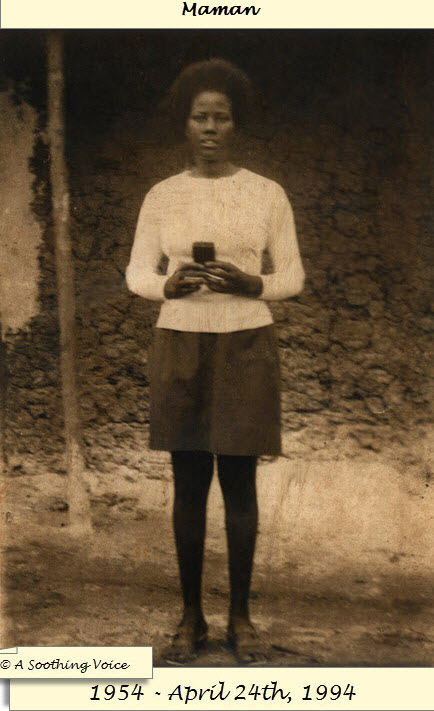
My dearest Mom, the source of my inspiration!
When the genocide against the Tutsi began on April 7, April 1994, her daily prayer was heartbreaking: that if death was coming, it would come quickly—and take us all together. She didn’t believe any of us could survive alone. Seventeen days later, she was gone
Mama, four of us survived. And we didn’t just make it—we rose. The God you taught us to trust has carried us every step of the way. We miss you more than words can ever say, but we know you’re home with Him now. I promise—we will finish what you started!
One story I will never forget is the dream one aunt had in 1993, a year before the genocide. In that dream, she saw a terrible tragedy coming to Rwanda—people being killed, chaos everywhere. As she faced death in the dream, she cried out in prayer that my mother would survive. She believed and was certain that, if my mother lived, she would raise her children as her own.
That was the kind of woman my mom was—so full of love, even those outside our immediate family entrusted her with their children in their final thoughts. She was selfless in the deepest sense, giving her all for her family and others, never seeking recognition. Even as the genocide began, her final prayer wasn’t for escape—it was for her family to die together, quickly and without pain. She couldn’t bear the thought of her children suffering or surviving alone.
That level of sacrifice, of love, lives in me every day. Her story didn’t end with her death. It continues through the lives of the children she raised, the values she instilled, and the legacy we carry forward.
After the genocide, I made a silent vow: I would never call anyone Mom again. The word felt sacred—untouchable. Hearing others speak of their mothers only deepened the ache inside me. I kept that promise for 14 years.
Then, in 2008, God surprised me with a miracle named Glori. We met at a mutual friend’s dinner in Rochester, New York, and from the beginning, there was something different—something gentle, yet strong. A few months later, she gave me a gift I never thought I’d receive again: the invitation to call her Mom.
For the first time since 1994, someone called me “daughter.” And in that moment, something long-buried within me softened.
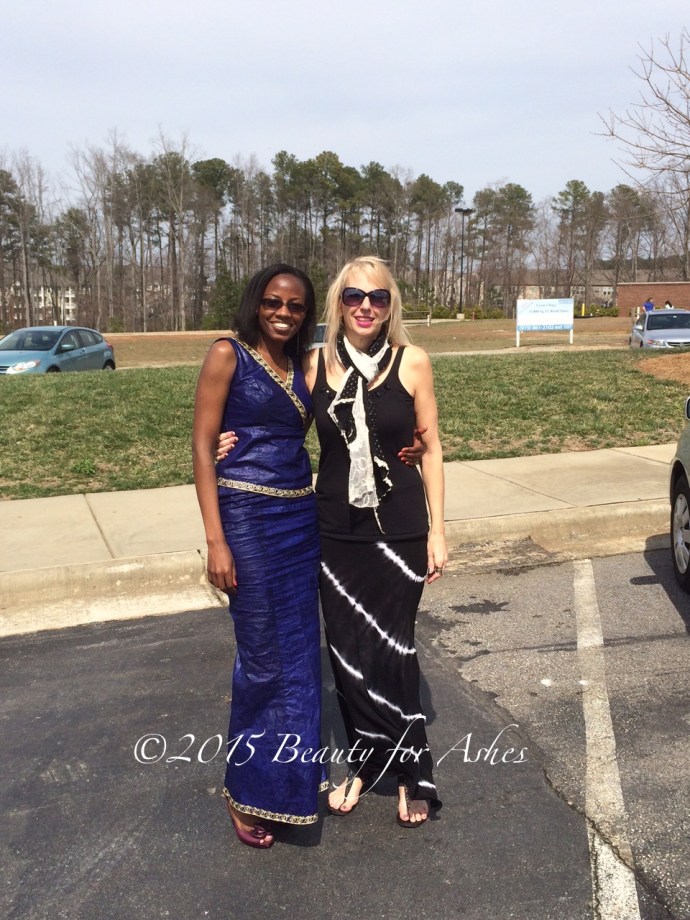
With my mom in town on my birthday: March 2014 (Raleigh, NC)
Glori loves in the most practical, powerful ways—reminding me to eat, giving advice, printing directions even though I have GPS, flying in every year to celebrate my birthday. When I visit her, she plans my time down to the minute, knowing how much I love my sleep and how long it takes me to get ready. I eat like a child at her table, wrapped in warmth I thought I’d lost forever.
It’s uncanny how much we have in common—our laughter, our passions, even the way we do things. It feels as if God, in His mercy, wove pieces of Colette into Glori, so I would always feel my mother’s love—just in a new form.
I never imagined I’d say “Mom” again. Now I say it with joy, with gratitude, and with a heart full of reverence. Colette gave me life. Glori gave me healing. And through them both, God showed me the fullness of His love.
If your mom is still with you—hold her close. If she’s in heaven, speak her name. Write her story. Keep her legacy alive.
I am the daughter of two extraordinary women. And I am blessed beyond measure.


 Beauty for Ashes