Inconceivable Heroism Amid Horror

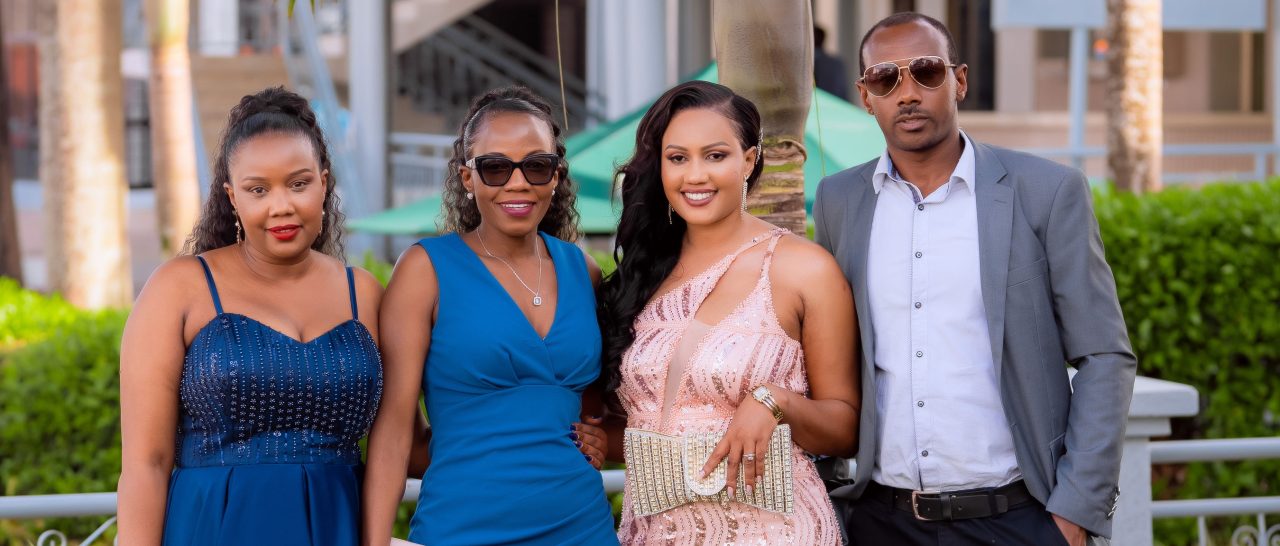
My siblings and I grew up in a large family: two boys and four girls. I am the second and oldest girl; but this post is not about me. I want to share with the world about the fourth child, my little brother Jean Eric Claude. I vividly remember when he was born, I was almost 5 years old. He was a big baby (about 10 pounds), extremely beautiful with chubby cheeks and so much curly hair. I asked my mother if I could hold him, but I was unable to because he was too heavy for me. I am sure you are wondering if I am describing the right person basing on the below picture. By the way, that makes two of us! I am not sure how he grew up to become thinner than the rest of the family.

When Eric was young, him and I used to fight a lot. I am sure I provoked him but he was not that easy either. He played outside always, and was injured all the time from different utensils he collected or perhaps some fights he may have been involved in. He was a stubborn little guy.

On Sunday afternoon, April 24th, 1994, exactly 17 days since the genocide against the Tutsi began in Rwanda, everything changed! God must have stirred something unimaginable in this 8 year old’s heart after my Mom, my old brother Jean Felix, my cousin and I were led by the infamous interahamwe militiamen to the mass grave in the lower Kanombe, suburbs of Kigali, to be killed.

Sparing you the details for now, I miraculously survived but my Mom, brother and cousin didn’t. Although death was everywhere, I undoubtedly cherish that afternoon because God gave me another chance to life. However, the same day I got separated from my brother Eric, and sisters Alice and Mireille, who were all under 10. At this point, they were so certain I was dead, and I thought the same for them.

My handsome brother

My handsome brother, now a grown up man! I’m eternally honored to be called his sister.

With no instructions on what to do next or a moment to think about it, my baby brother immediately assumed the role of a big brother and a parent. Fleeing amid rain of bullets, blood thirst machetes and hiding in unfamiliar areas, he tied up a piece of blanket around his neck so his two sisters could hold on to it.

Sigh…

I often wonder how the blanket didn’t choke him or how he figured out that this would be the best approach for his dear sisters. Few times, the youngest Mireille who was 3, got separated from them; unable to decide what to do, she would simply stay wherever she was left. Was she scared? When you are aware that death awaits you any minute, the sense of feeling becomes numb, even at such age.
As soon as my brother realized that she was missing, when parents left babies to cry to death and everyone was just running for their life, my brother turned around to look for Mireille. No wonder why their hearts have been knitted together ever since!
Also each time they found something to eat after days, my little brother would let my sisters eat first. After they have had enough in their little tummies, only then he would grab some.
Their stories after we got separated still wound my heart greatly. It certainly is where my forgiveness is tried the most. But I praise GOD, for keeping them safe, allowing me to be part of their precious lives, and His amazing Grace!

The spoiled brat quickly became a MAN at that young age, a selfless one. I doubt I would have been able to put my life in danger to find my little sister or keep them safe, when sounds of terror and weeping voices of sorrow rang across all corners of the country. Only extraordinary, rare people would do that. I often wonder what was in his mind, but the LOVE he had for his little sister sure overcame his fear and selfishness of saving his own life. God Almighty knew well that I was incapable of doing such a heroic act and led me alone.

Mireille and Alice: My greatest happiness!

My Beautiful Girls, my Greatest Blessing, my Treasure! Mireille (left) and Alice (right).

Only those who have been through a genocide can understand my inability to describe the cruelty of the humans who became ferocious animals: babies were cut out of their mothers’ wombs and smashed against walls; relatives denied each other, neighbors turned their back on their friends, husbands killed wives and children, hell engulfed Rwanda. Amid terror, my little brother didn’t care about death that surrounded him, and God used him to keep my little sisters alive. He is my hero, my best friend! If I could get hold of the whole world, I would freely give it to him; if I was part of the Nobel Prize organizing committee, he would get at least a few of those!

My brother’s last name “Mudacumura”, means “innocent in both English and French. This truly depicts who he is. He has every quality you can possibly look in a great man: selflessness, humility, passion, compassion, a big heart, brilliant, kindness, funny, sweet, down to earth, loves God, handsome, a true gentleman! Until this day, he puts his siblings’ interests before his. He is the rock of our family, an exact replica of our father.

I CANNOT wait already for the day he will tie the knot with this incredible woman of his dreams, probably the luckiest girl on this planet. No one deserves happiness more than him. And I can’t wait for the day we will again see our parents, so I can narrate all about a little boy they left behind, now the most amazing man in the whole wide world.

I love my brother with everything functioning in me. Him and his two sisters are the reason I am alive, there is no doubt about that.

They will never, EVER, need anything my ability can provide; God and my parents in heaven have my word!

It hurts my feelings when I think that one day I may not be the first person they all run to for help. Of course I work hard for their independence, but it will greatly shatter my heart. They will always be my children, little in my eyes. And they certainly have all my love and attention, all my days!!!
And this, my friends, is the source of my strength and hope: God, the great I am!

God is not “Fair”. He is JUST!

By definition, being fair means being free from bias, dishonesty, or injustice. A fair decision, a fair judge—something done properly under the rules. When we receive what we rightly deserve in a good way, we call it fairness. Ideally, systems of justice should be fair.

But God is not “fair”—at least not by human standards. Fairness, as we define it, is shaped by our perspective, not His. Take Psalm 103:10 (NKJV): “He has not dealt with us according to our sins, nor punished us according to our iniquities.” That’s not fairness—it’s mercy. And if you keep reading through verse 14, mercy, not fairness, becomes the focus.

If God was fair in the way we expect, tragedies wouldn’t happen. He doesn’t cause them, yet He allows them. And yes, He has the power to stop them. But we often try to make sense of pain through our human lens of what is “right” or “fair”—which doesn’t always align with God’s greater purpose.

Consider these examples:

The tornado that devastated Moore, Oklahoma was heartbreaking. The emotional reunions of parents and their children who survived the destruction of two elementary schools were moving. Meanwhile, other families waited in anguish for news of loved ones—some with devastating outcomes.

Or the collapsing garment factory in Bangladesh, where workers earning meager wages died as the death toll rose by the minute—an unfathomable loss.

Then there’s the 2010 earthquake in Haiti that reduced its capital Port-au-Prince to rubble. More than 200,000 lives were lost, and the nation suffered immense, lasting damage. I vividly remember waiting to hear if my dear grad school friend, Katarina, her husband, and their infant son had survived. By God’s grace, they did, though they lost everything they owned in Port-au-Prince. Their survival still feels miraculous.

And of course, the 1994 genocide against the Tutsi in Rwanda—one of the most horrific atrocities of the 20th century. In just 100 days, over a million Tutsi were killed. Roméo Dallaire, the Canadian UN Force Commander at the time, shared his firsthand account in “Shake Hands with the Devil“—a book I strongly recommend.

These are only a few examples. Sadly, tragedies continue even as I write this. Most often, the victims have nothing to do with the cause of their suffering. But the point is not to measure who has suffered the most or who deserves the most attention. It’s about what we learn in the aftermath—and how we find God’s power and presence in the middle of the storm.

To our human minds, it feels deeply unfair when innocent people suffer, when children die, or when bad things happen to good people while bad people thrive. In those moments, we cry out, “Where is God?” In Rwanda, many later echoed the haunting belief that the “God of Rwanda” went silent starting April 7, 1994.

Sometimes, we even try to rewrite God’s plans: “If only God had been there…” But we’re not alone in that thinking. When Jesus arrived after Lazarus had died, Martha said, “Lord, if You had been here, my brother would not have died.” (John 11:21). Yet Jesus came not just to heal—but to raise Lazarus, so that God’s glory would be revealed. A healing would have been amazing. But resurrection? That was undeniable.

The truth is, every person—no matter how composed they may seem—faces their own struggles. We all experience hardship, but the good news is found in 1 Corinthians 10:13: “No temptation has overtaken you except such as is common to man; but God is faithful, who will not allow you to be tempted beyond what you are able, but with the temptation will also make the way of escape, that you may be able to bear it.”

So no, God is not “fair” by our limited standards—but He is Just. He is omnipresent, omnipotent, and omniscient. It’s not that people or places are cursed and “deserve” tragedy. As Matthew 5:45 reminds us, “For He makes His sun rise on the evil and on the good, and sends rain on the just and on the unjust.”

God is our Healer, Counselor, Father to the fatherless—overflowing with mercy and grace. But His schedule, His wisdom, His judgment—none of it is reasonable by our terms. His ways are not our ways. His thoughts are far above our thoughts. You can’t advise Him or question His will. He does all things according to His purpose—on earth as in heaven.

God does not cause earthquakes, hurricanes, or tornadoes—but He is there in the midst of them. And when we hear the stories of those who survive against all odds, we know it’s not by their strength—but by His grace.

So trust Him—even when the world falls apart. You are safe in His arms.

Mourn with those who mourn. Rejoice with those who rejoice. Cherish every day. Offer help when you can—you never know when you might need it. Be compassionate, mindful, and generous. Treat others the way you’d hope to be treated.

May God comfort those who mourn today. May He bring healing to the broken, peace to the suffering, and hope to the weary. In Jesus’ Name, may all who are in distress hear His soothing voice and be lifted up.

May His holy name be praised, now and forever!

“To describe my mother would be to write about a hurricane in its perfect power.” — Maya Angelou

“Behind all your stories is always your mother’s story, because hers is where yours begin.” — Mitch Albom

It’s hard for me to understand when people say they aren’t close to their parents or siblings. I know every family is different—and sometimes painful distance is necessary. But I also know this: children never ask to be born, and too often they pay the price for a broken foundation they didn’t break.

In Rwanda, family isn’t just important—it’s sacred. You’re expected to stay connected not just to your parents and siblings, but to your entire extended family. That’s the world I was born into, and the world my mother, Colette, exemplified.

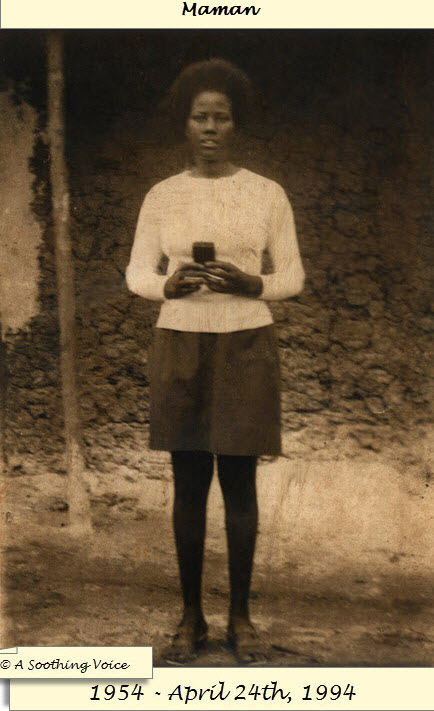
She was everything a mother could be: selfless, present, unwavering. As the eldest girl in a family of six, I should’ve seen her worries—but I didn’t. She shielded us from life’s hardest parts. If she and my father argued, we never heard it. If money was tight, we never felt it. She made our world feel like paradise.

She didn’t say “I love you” with words—we didn’t do that in our culture—but we knew. Through her care, her sacrifices, the small rewards when we succeeded. Even as we had house help, she ensured we learned to contribute, to grow.

My dearest Mom, the source of my inspiration!

When the genocide against the Tutsi began on April 7, April 1994, her daily prayer was heartbreaking: that if death was coming, it would come quickly—and take us all together. She didn’t believe any of us could survive alone. Seventeen days later, she was gone

Mama, four of us survived. And we didn’t just make it—we rose. The God you taught us to trust has carried us every step of the way. We miss you more than words can ever say, but we know you’re home with Him now. I promise—we will finish what you started!

One story I will never forget is the dream one aunt had in 1993, a year before the genocide. In that dream, she saw a terrible tragedy coming to Rwanda—people being killed, chaos everywhere. As she faced death in the dream, she cried out in prayer that my mother would survive. She believed and was certain that, if my mother lived, she would raise her children as her own.

That was the kind of woman my mom was—so full of love, even those outside our immediate family entrusted her with their children in their final thoughts. She was selfless in the deepest sense, giving her all for her family and others, never seeking recognition. Even as the genocide began, her final prayer wasn’t for escape—it was for her family to die together, quickly and without pain. She couldn’t bear the thought of her children suffering or surviving alone.

That level of sacrifice, of love, lives in me every day. Her story didn’t end with her death. It continues through the lives of the children she raised, the values she instilled, and the legacy we carry forward.

After the genocide, I made a silent vow: I would never call anyone Mom again. The word felt sacred—untouchable. Hearing others speak of their mothers only deepened the ache inside me. I kept that promise for 14 years.

Then, in 2008, God surprised me with a miracle named Glori. We met at a mutual friend’s dinner in Rochester, New York, and from the beginning, there was something different—something gentle, yet strong. A few months later, she gave me a gift I never thought I’d receive again: the invitation to call her Mom.

For the first time since 1994, someone called me “daughter.” And in that moment, something long-buried within me softened.

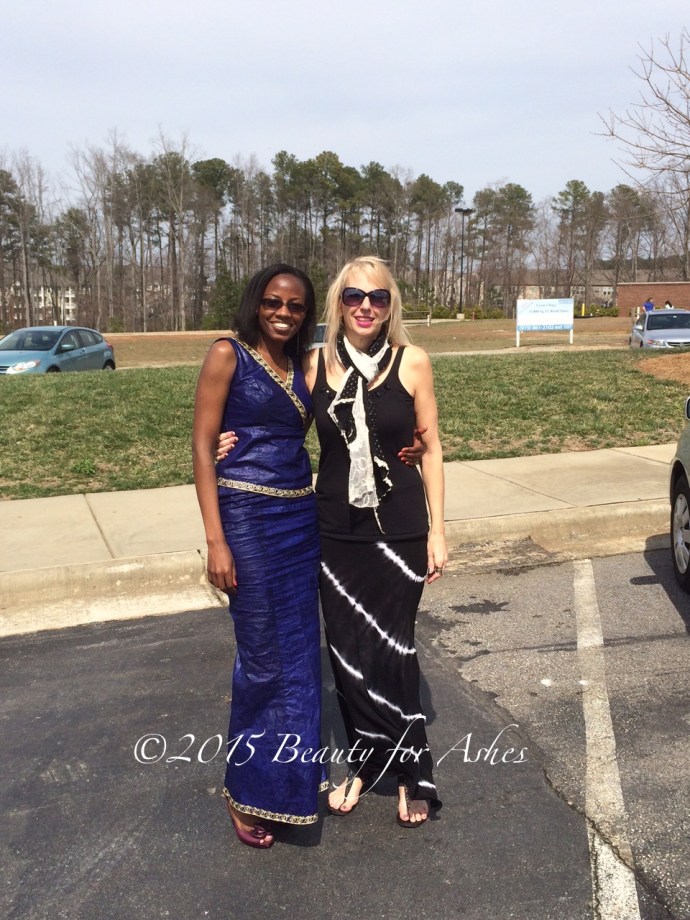
Maman et moi. Mars 2014

With my mom in town on my birthday: March 2014 (Raleigh, NC)

Glori loves in the most practical, powerful ways—reminding me to eat, giving advice, printing directions even though I have GPS, flying in every year to celebrate my birthday. When I visit her, she plans my time down to the minute, knowing how much I love my sleep and how long it takes me to get ready. I eat like a child at her table, wrapped in warmth I thought I’d lost forever.

It’s uncanny how much we have in common—our laughter, our passions, even the way we do things. It feels as if God, in His mercy, wove pieces of Colette into Glori, so I would always feel my mother’s love—just in a new form.

I never imagined I’d say “Mom” again. Now I say it with joy, with gratitude, and with a heart full of reverence. Colette gave me life. Glori gave me healing. And through them both, God showed me the fullness of His love.

If your mom is still with you—hold her close. If she’s in heaven, speak her name. Write her story. Keep her legacy alive.

I am the daughter of two extraordinary women. And I am blessed beyond measure.