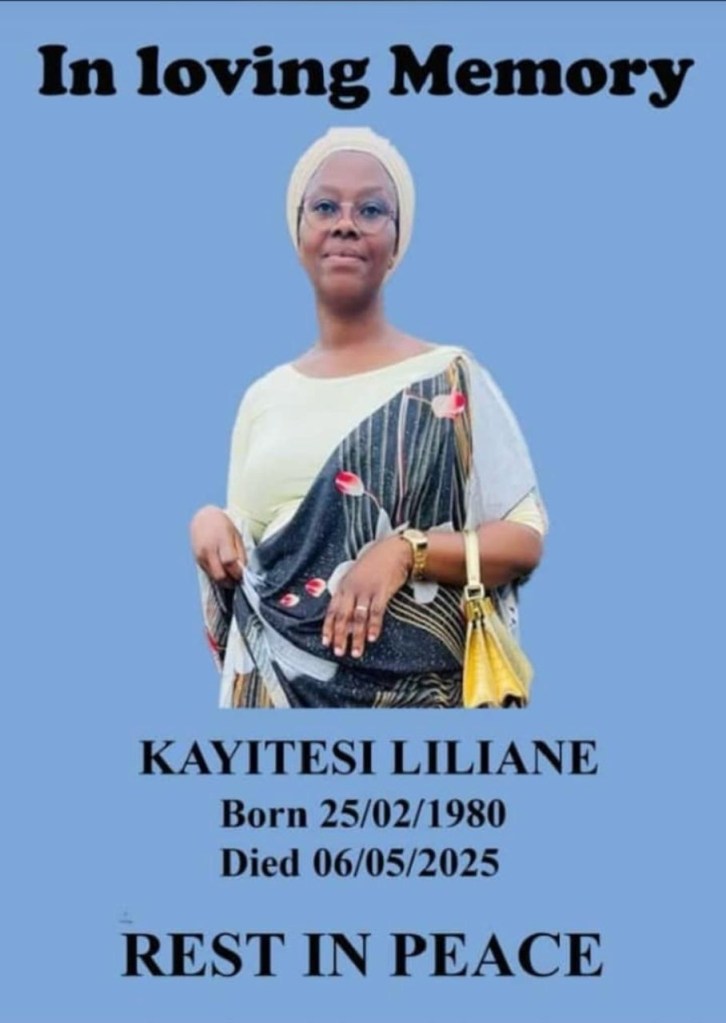
A righteous one has fallen đź’”

For you, Lily!

A gem is taken, how can it be?
How dare the world go on
as if nothing has shattered?
The sun still rises —
oblivious to all that’s been lost.
Do they not see
a light has gone out in our generation?

Lily, my sweet cousin, my sister,
you were woven into the fabric of my childhood —
bound by friendship that run deep,
laughter that found us even in the hard times.
We’d look back on those days
and marvel at how far we’d come,
how grace carried us through storms.


You were the best of us, Lily.

You held softness like breath,
kindness like a second skin.
You never raised your voice,
wouldn’t hurt a fly,
and carried everyone else’s burdens
without complaint, or judgement,
as though your heart was made to shelter the world.

You loved Jesus with a fierce, quiet fire.
Not performative. Not loud.
Just deep, real, unshakable.
I’ve known many people,
but few I would call righteous—
you were one of them.
You loved without limits,
cared without keeping score,
gave of yourself and asked for nothing.

With your other half!

You were the Proverbs 31 woman—
for your children, for your home.
Clothed in dignity, love on your tongue,
your life was a sermon they watched daily.
You rose early, gave endlessly,
and your children called you blessed.

And now you leave behind a husband,
beautiful children—
too young to lose their mother,
too young to understand
why love sometimes gets taken too soon. Oh heaven’s gain!
We weren’t ready Lily, we never would be.

Say hi to your aunt—my mom—for me.
What an incredible reunion that must be!
Tell her I miss her every single day.
And tell Papa, Manyike and Nkeke.
Tell them grief still lingers like smoke here.

How I wish this were like Tabitha’s story—
where the widows wept with such aching love,
that life was summoned back from death.

I am weeping.
My soul is heavy.
I have more to say—so much more.
Too much silence between us now,
too much unsaid.

The righteous has left us,
and the earth should tremble in mourning.
I will carry you—
your memory etched in every heartbeat,
until we see each other again,
where no goodbye will ever be needed.

“Well done, good and faithful servant.
Enter into the joy of your Lord.”

(Matthew 25:23)

The Art of Trust: Our Assurance!

“Blessed is the man who trusts in the Lord, and whose hope is the Lord. For he shall be like a tree planted by the waters, which spreads out its roots by the river, and will not fear when heat comes; but its leaf will be green, and will not be anxious in the year of drought, nor will cease from yielding fruit.Jeremiah 17:7-8

Sometimes, when I share my experience during the 1994 Rwandan genocide against the Tutsi and its aftermath, my audience often asks me what I struggled the most with after the loss I endured. I have talked about the pain of watching my siblings especially my youngest sister Mireille who doesn’t recall much about our childhood or our loved ones we lost during the genocide against the minority Tutsi ethnic group in Rwanda. This truly breaks my heart. I also talk about how God enabled me to forgive my family members’ killers. However, there is something else I don’t say often.

Trust2

Trusting people does not come to me easily. As I talk more about my personal life, my failures and fears, although I must admit that it has been both challenging and thrilling, it has certainly helped me with healing and forgiving. I am very thankful for another chance I have been given to life and the great opportunity to be able to share my story with all kinds of people. It may help someone. However, I still struggle to trust people.

It’s still painful to grasp that neighbors who spoke the same language, whose children we attended the same school and played together, worshiped at the same mass every Sunday, would murder their fellow neighbors, people who meant the world to me. It hurts so badly to feel abandoned by relatives when you’re young and need them the most. It changes everything when love is taken away from you at a very young age and people who should care don’t feel empathy toward your horrifying circumstances.

It absolutely hurts when a friend you trust so much lets you down or people you rely on are not there when you need them the most. It is disappointing when you share a personal struggle with someone but they don’t take it seriously. It hurts when you have expectations for certain people and trust them but they turn their back on you when you need them. It is heartbreaking when a religious leader you look up to turns out to be your worst nightmare.The list goes on..

trust

The truth is that, people will probably let you down. Unfortunately some people change and we often make wrong choices. We are human beings and the devil takes advantage of our weaknesses. But also, Timothy explains what is to come:

“But understand this, that in the last days, there will come times of difficulty. For people will be lovers of self, lovers of money, proud, arrogant, abusive, disobedient to their parents, ungrateful, unholy, heartless, unappeasable, slanderous, without self-control, brutal, not loving good, treacherous, reckless, swollen with conceit, lovers of pleasure rather than lovers of God, having the appearance of godliness, but denying its power. Avoid such people” 2 Timothy 3:1-5

Nonetheless, you’re not meant to place your trust in your friends; there is not a single person in this world who is perfect. On the contrary, you are called to love everyone unconditionally and put your TRUST in GOD alone. He is the only one who will NOT: disappoint you, let you down, turn his back on you, forget about you, leave you as orphan, irritate you, or delay.

You can trust that God understands your pain better than anyone else and that He will come to your rescue. Even though people may not be there for you, God will never let you down! You can trust Him fully and fix your eyes on Him! When you feel all alone and disappointed, remember that you are not into this alone. You can trust God with all your life!

Although it is a great weakness of mine to open up and trust easily, God Has been patient with me. He Has enabled me to trust Him completely first and foremost, and to forgive when people I am able to trust let me down. His Grace has also been overflowing through seeking forgiveness when I am not there for those who need me the most. Thank God for His wonderful promises we have been given:

“Can a woman forget her nursing child, and not have compassion on the son of her womb? Surely they may forget, Yet I will not forget you. See, I have inscribed you on the palms of My hands; Your walls are continually before Me.” Isaiah 49: 15-16

“Those who trust in the Lord are like Mount Zion, which cannot be moved, but abides forever.” Psalm 125:1

“When you pass through the waters, I will be with you; and through the rivers, they shall not overflow you.
When you walk through the fire, you shall not be burned, nor shall the flame scorch you. For I am the Lord your God, the Holy One of Israel, your Savior”. Isaiah 43: 2-3

God is not “Fair”. He is JUST!

By definition, being fair means being free from bias, dishonesty, or injustice. A fair decision, a fair judge—something done properly under the rules. When we receive what we rightly deserve in a good way, we call it fairness. Ideally, systems of justice should be fair.

But God is not “fair”—at least not by human standards. Fairness, as we define it, is shaped by our perspective, not His. Take Psalm 103:10 (NKJV): “He has not dealt with us according to our sins, nor punished us according to our iniquities.” That’s not fairness—it’s mercy. And if you keep reading through verse 14, mercy, not fairness, becomes the focus.

If God was fair in the way we expect, tragedies wouldn’t happen. He doesn’t cause them, yet He allows them. And yes, He has the power to stop them. But we often try to make sense of pain through our human lens of what is “right” or “fair”—which doesn’t always align with God’s greater purpose.

Consider these examples:

The tornado that devastated Moore, Oklahoma was heartbreaking. The emotional reunions of parents and their children who survived the destruction of two elementary schools were moving. Meanwhile, other families waited in anguish for news of loved ones—some with devastating outcomes.

Or the collapsing garment factory in Bangladesh, where workers earning meager wages died as the death toll rose by the minute—an unfathomable loss.

Then there’s the 2010 earthquake in Haiti that reduced its capital Port-au-Prince to rubble. More than 200,000 lives were lost, and the nation suffered immense, lasting damage. I vividly remember waiting to hear if my dear grad school friend, Katarina, her husband, and their infant son had survived. By God’s grace, they did, though they lost everything they owned in Port-au-Prince. Their survival still feels miraculous.

And of course, the 1994 genocide against the Tutsi in Rwanda—one of the most horrific atrocities of the 20th century. In just 100 days, over a million Tutsi were killed. RomĂ©o Dallaire, the Canadian UN Force Commander at the time, shared his firsthand account in “Shake Hands with the Devil“—a book I strongly recommend.

These are only a few examples. Sadly, tragedies continue even as I write this. Most often, the victims have nothing to do with the cause of their suffering. But the point is not to measure who has suffered the most or who deserves the most attention. It’s about what we learn in the aftermath—and how we find God’s power and presence in the middle of the storm.

To our human minds, it feels deeply unfair when innocent people suffer, when children die, or when bad things happen to good people while bad people thrive. In those moments, we cry out, “Where is God?” In Rwanda, many later echoed the haunting belief that the “God of Rwanda” went silent starting April 7, 1994.

Sometimes, we even try to rewrite God’s plans: “If only God had been there…” But we’re not alone in that thinking. When Jesus arrived after Lazarus had died, Martha said, “Lord, if You had been here, my brother would not have died.” (John 11:21). Yet Jesus came not just to heal—but to raise Lazarus, so that God’s glory would be revealed. A healing would have been amazing. But resurrection? That was undeniable.

The truth is, every person—no matter how composed they may seem—faces their own struggles. We all experience hardship, but the good news is found in 1 Corinthians 10:13: “No temptation has overtaken you except such as is common to man; but God is faithful, who will not allow you to be tempted beyond what you are able, but with the temptation will also make the way of escape, that you may be able to bear it.”

So no, God is not “fair” by our limited standards—but He is Just. He is omnipresent, omnipotent, and omniscient. It’s not that people or places are cursed and “deserve” tragedy. As Matthew 5:45 reminds us, “For He makes His sun rise on the evil and on the good, and sends rain on the just and on the unjust.”

God is our Healer, Counselor, Father to the fatherless—overflowing with mercy and grace. But His schedule, His wisdom, His judgment—none of it is reasonable by our terms. His ways are not our ways. His thoughts are far above our thoughts. You can’t advise Him or question His will. He does all things according to His purpose—on earth as in heaven.

God does not cause earthquakes, hurricanes, or tornadoes—but He is there in the midst of them. And when we hear the stories of those who survive against all odds, we know it’s not by their strength—but by His grace.

So trust Him—even when the world falls apart. You are safe in His arms.

Mourn with those who mourn. Rejoice with those who rejoice. Cherish every day. Offer help when you can—you never know when you might need it. Be compassionate, mindful, and generous. Treat others the way you’d hope to be treated.

May God comfort those who mourn today. May He bring healing to the broken, peace to the suffering, and hope to the weary. In Jesus’ Name, may all who are in distress hear His soothing voice and be lifted up.

May His holy name be praised, now and forever!